

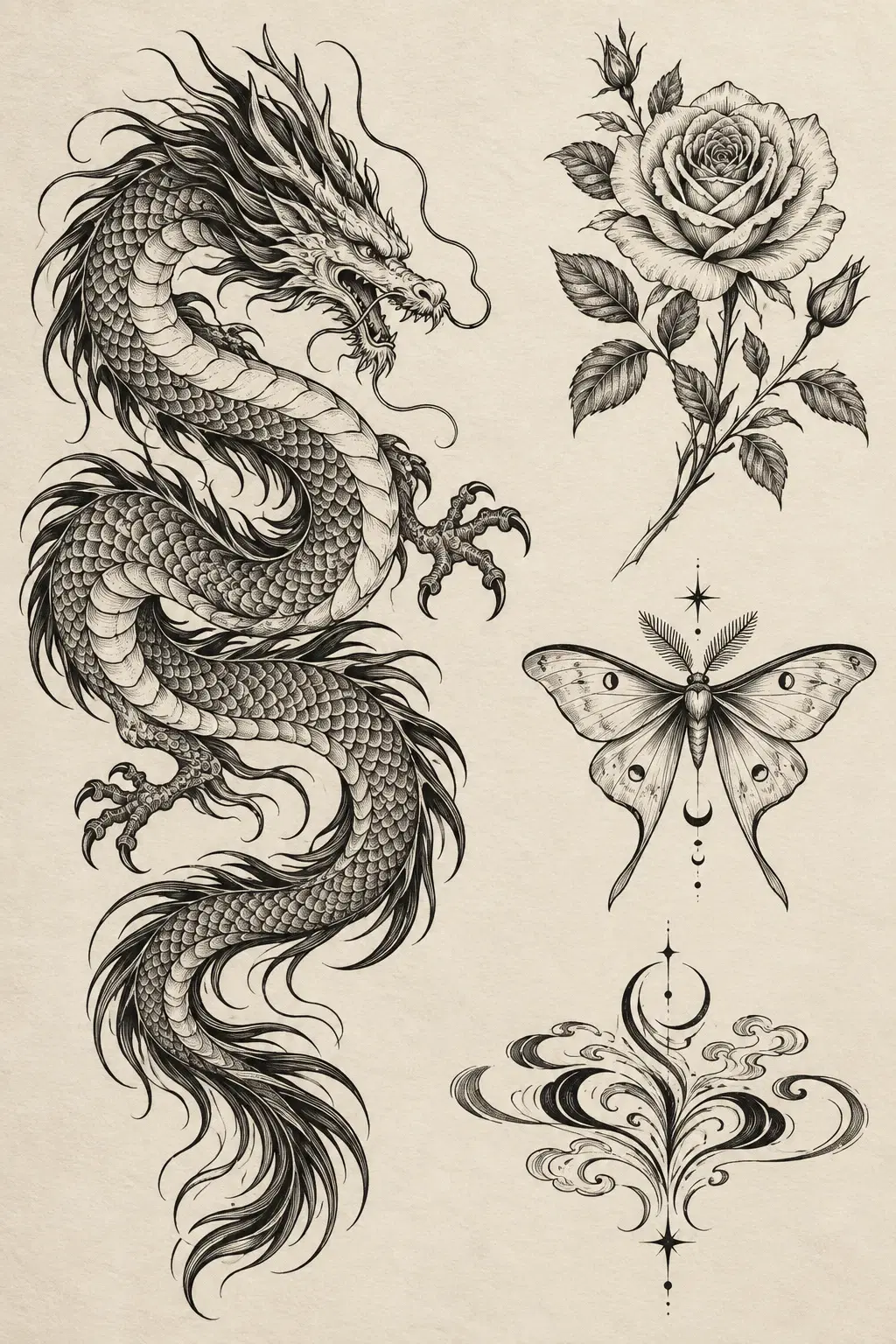
A dragon tattoo commonly represents power, protection, wisdom, transformation, or freedom, but its meaning changes with cultural tradition and visual treatment. East Asian dragons are often associated with water, balance, authority, and good fortune, while many European traditions emphasize guardianship, danger, conquest, or untamed force.
Common dragon tattoo meanings
Strength and protection are frequent readings because dragons are imagined as formidable guardians. Wisdom and transformation emerge when the creature is shown as ancient, controlled, or moving between elements. A dragon in flight may emphasize freedom; a coiled dragon can suggest contained energy or watchfulness.
- Power and courage
- Protection and guardianship
- Wisdom and self-mastery
- Transformation and renewal
- Freedom and elemental force
Variations change the story
A long, flowing dragon works naturally with Japanese or Chinese-influenced compositions and can wrap around a limb or travel across the back. A winged European dragon creates a heavier silhouette suited to illustrative, blackwork, or realism approaches. A dragon with clouds, waves, fire, a pearl, flowers, or a sword adds another symbolic layer that should be planned as one composition rather than assembled from isolated symbols.
- Ascending dragon: ambition, movement, or emergence
- Descending dragon: protection, return, or controlled power
- Dragon and flower: contrast between force and growth
- Dragon and waves or clouds: an elemental, atmospheric composition
Style and placement considerations
Japanese, illustrative, blackwork, fine-line, and ornamental treatments can all work, but not at the same scale. Detailed scales, claws, facial features, and background elements need enough space to remain readable. The back, thigh, chest, upper arm, and sleeve offer room for movement; a forearm design usually benefits from a simplified vertical silhouette.
Ask an artist whose healed portfolio shows the relevant tradition and scale. The body should determine the curve and direction of the dragon rather than forcing a flat reference onto a moving surface.
Cultural context matters
There is no single universal dragon. Chinese, Japanese, Korean, Celtic, Norse, and European imagery have distinct histories and visual conventions. Research the specific attributes, avoid casually combining sacred or culturally specific elements, and discuss the reference with an artist who understands the tradition you are drawing from.